Active · 2016 –
Attosecond imaging of plasmonic near fields
Reconstructing the field around a nanoparticle from streaked photoelectron spectra, with nanometer spatial and sub-femtosecond temporal resolution.
The question
When light drives a metal nanoparticle, the particle radiates a near field of its own. That field is confined to a few nanometers around the surface and rises and falls within a few hundred attoseconds. It is the quantity that makes nanoplasmonics useful, and it is difficult to observe: it is smaller than the wavelength that created it, so no optical instrument resolves it in space, and faster than any detector, so nothing resolves it directly in time.
The way around this is to measure something that was inside the field. A photoelectron released near the surface is accelerated by the near field on its way out, and arrives at the detector carrying a record of what the field was doing while it left.
Approach
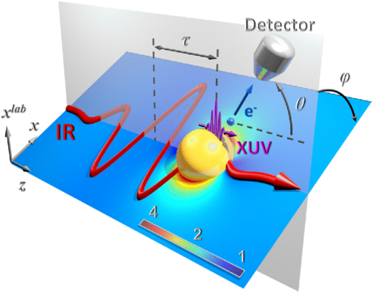
Attosecond streaking, applied to a nanoparticle rather than a gas. An XUV pulse releases the electron at a known instant, and a delayed infrared pulse drives the plasmonic response that streaks it. Scanning the delay maps the shift in final momentum, and the near field is reconstructed from that map.
We developed two models, which answer different questions.
The classical model proceeds in four steps: XUV excitation, electron transport inside the nanoparticle, escape through the surface, and propagation to the detector, with spectra obtained by sampling classical trajectories. It is inexpensive enough to sweep across particle size, material, and geometry.
The quantum model computes the infrared-induced plasmonic field from Mie theory and the photoemission amplitudes from T-matrix elements. It costs considerably more, and it settles the questions the classical treatment cannot be trusted on: what the finite duration of the XUV pulse does to the reconstruction, and how much of the measured shift comes from the electron's interaction with the surface it just left rather than from the field being measured.
Results
Used together, the two models gave a reconstruction of the induced plasmonic field with nanometer spatial and sub-femtosecond temporal resolution, reported in Physical Review Letters in 2018. The companion papers establish the conditions under which that reconstruction is faithful rather than merely stable, and extend the treatment from gold to transition-metal nanospheres.
Open problems
Imaging plasmon dynamics during strong-field ionization. Work in the strong-field project predicts that heavy photoemission reduces the plasmonic field enhancement. This reconstruction method is the natural way to observe that reduction as it happens, which would connect the two lines of work directly.
Shape. Everything above assumes a sphere. Real samples are not spherical, and the near field of a particle with a facet or a corner concentrates exactly where the current approximations are weakest. Extending the reconstruction to such shapes is open.
Links
- Imaging plasmonic fields with atomic spatiotemporal resolutionPhys. Rev. Lett. 120, 223903 (2018)
- Spatiotemporal imaging of plasmonic fields near nanoparticles below the diffraction limitPhys. Rev. A 98, 063422 (2018)
- Characterization of induced nanoplasmonic fields in time-resolved photoemissionPhys. Rev. A 95, 053406 (2017)
- Attosecond time-resolved streaked photoelectron spectroscopy of transition-metal nanospheresPhys. Rev. A 95, 043423 (2017)
- Retrieving plasmonic near-field information: a quantum-mechanical modelPhys. Rev. A 94, 051401(R) (2016)